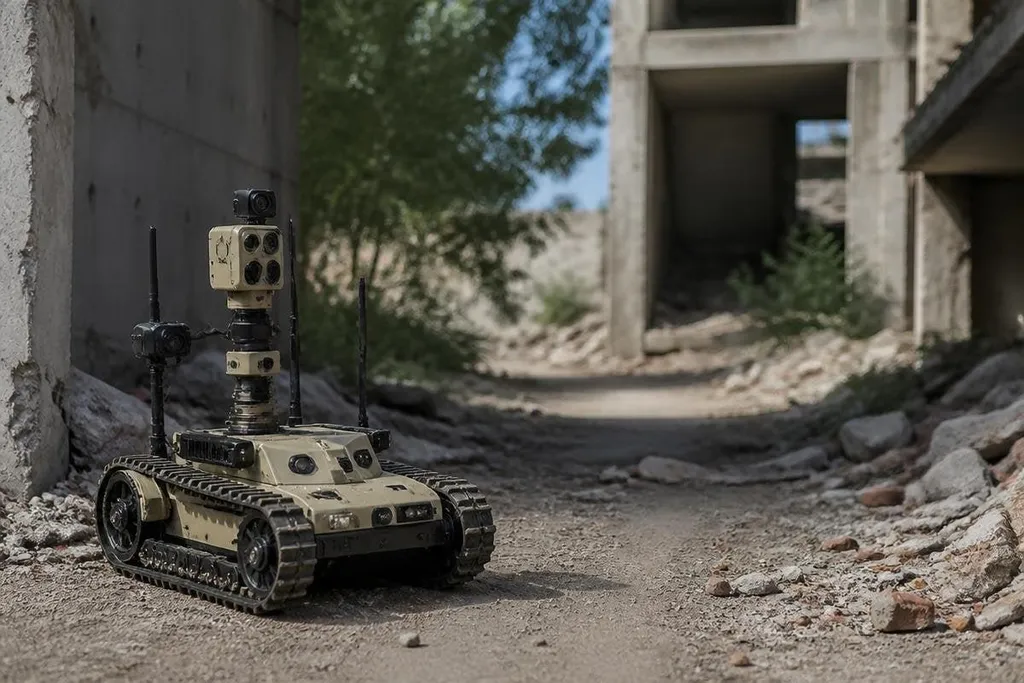
AI gives military robots software that can sort sensor data, spot objects, and suggest or carry out an action. The hard part is keeping those actions safe when radio links fail, dust blocks a camera, or a person enters the robot’s path.
- Cameras and LiDAR help a robot build a view of its surroundings.
- AI can sort objects and movement faster than a remote operator.
- Human control remains important when the cost of a wrong action is high.
Where AI fits inside a military robot
A military robot usually combines sensors, computers, motors, and a communications link. AI sits in the software layer. It reads inputs from cameras, LiDAR, heat sensors, or microphones, then estimates what the robot sees and where it can move.
That estimate can guide several tasks. A ground robot may follow a route, avoid a wall, or stop when its camera detects a person.
A drone may keep its position while an operator sends new instructions. A robotic arm may sort an object by its shape instead of waiting for a fixed command for every movement.
The machine still needs rules around those choices. A model can label a shape incorrectly, especially when smoke, low light, camouflage, or rain changes the image. The robot needs a safe stop, a clear record of its decisions, and a way for a person to take control.
What changes for the operator
Remote control asks a person to watch video and send commands. AI can handle small parts of that work, such as keeping a vehicle on a route or warning that a battery is low. That leaves the operator more time to review the wider situation.
This arrangement is often called supervised autonomy. The robot handles a defined task, while a person sets limits and can stop the action. The limits matter because a radio connection may drop, GPS signals may become unreliable, and the robot may meet something missing from its training data.
The result depends on the task. Carrying equipment across a marked area needs less judgment than moving through a crowded site. A robot that works well in a test yard may need new sensor checks before it can run near buildings, vehicles, or people.
A military robot can spot an object and still leave a person to decide what happens next. Robot24 puts AI claims beside the named robot, task, test setting, and operator, giving the next section a clear starting point: the limits AI cannot remove.
The limits AI cannot remove
AI does not remove the need for strong hardware. A camera still needs a clear view. A tracked vehicle still needs enough grip to cross loose ground. A radio still needs a usable link, and a battery still runs down.
Training data creates another limit. If the system has seen few examples of a damaged road, a partly hidden person, or an unfamiliar vehicle, its result may be wrong. The error may look small on a screen while causing a large problem outside the test area.
There is also a traceability problem. A person can explain why they issued a command. A machine-learning system may produce a label or route without giving a useful reason in plain language. Military teams need logs that show the sensor inputs, software version, operator commands, and safety stops used during an event.
I’d judge an AI military robot by its failure controls before its smoothest demo.
What to check before trusting a claim
The same checks help when you read a company release, watch a video, or compare two systems:
- Name the task: Is the robot carrying a load, mapping ground, watching an area, or choosing a route?
- Check the setting: Was the test run indoors, outdoors, in daylight, at night, or under poor weather conditions?
- Find the human role: Can an operator stop the robot, change its route, or take manual control?
- Ask what failed: Does the source show missed objects, lost links, low batteries, or recovery after an error?
- Separate software from hardware: A new AI model cannot fix a weak radio, poor traction, or a short battery run.
What happens next
The next useful step is clearer testing, not bigger claims. Military buyers will need results from the places where these robots must work, with records of failures and the time needed for a person to regain control.
Until those records are public, AI in military robots is best understood as a way to share or automate selected tasks. The open question is how often the system can fail safely when the sensors, software, and communications link all face pressure at once.